Friday, November 2, 2012

Our Emotional Life and Pain


While many of us think of pain in the traditional modality of the physical, often what gets overlooked is at how we can experience pain as a psychological relation to ourselves; and often what can and does occur, is that our untended mental states result in physical-pain.

I think this book by Brene' Brown is truly worth a read. So much pain in our culture is a result of people pushing themselves to the limits mentally and physically; not getting enough rest and just plain old continuing to attempt to "pick themselves up by their bootstraps".....which we all know by now is not possible, yet many continue to keep on trying.

Feelings of lack and not-enough-ness is rampant in our modern speedy culture. This emotional drain is a primary cause of  not only emotional but also physical pain. These is no doubt in my mind that this is true. So I invite you to watch her TED Talks if you have not already seen them and please do grab a copy of this book, read it and pass it along to a friend and loved-one.

Blessings of Health and Goodness to You All!

-DON:)

Saturday, September 29, 2012

Accupuncture Helps Fight Chronic Pain


Greetings everybody,
  As many of you may already know I am a fan of accupuncture. I have seen several practicioners over the years and have had great relief from various issues invloving body pain. Accupuncture also helps wth the whole body system and realy is a wholistic approach.

  I wanted to share with you all this Dr Mercola Article on it because I think he is right on. I hope you enjoy reading it: 


Many Blessings if Health and Goodness to You and Yours

The Wonders of Turmeric


Turmeric is truly a wonderful part of our spice world! 
Officially a rhizome, it has amazing and powerful healing potentials in the realms of enhancing our immune system.

I invite you all to watch a short video by Dr. Mercola and to read more about how Turmeric can enhance your body system towards a more robust and beautiful state.


Many Blessings if Health and Goodness to You and Yours

Friday, July 13, 2012

Alternatives To NSAID's (non-steroidal anti-inflammatory drugs)


Many people are quickly discovering that the damage done to the body by the NSAID drugs is significant. NSAID's (non steroidal anti-inflammatory drugs) also known as ibuprofen (Motrin) as well as many others (see below) are commonly used to manage pain.

The reality of what these drugs do to our digestive systems & stomach health, our arteries and kidney and liver is truly staggering when the research is read through carefully. It is amazing to me that these drugs are legal to sell at all, and yet it is one of the most robust sections of pharmaceutical sales in the world today!

As you may know by now, Ginger and Turmeric are fabulous anti-inflammatory agents and truly support the very same systems that the NSAID's tear down. Ginger has been reported again and again to actually repair the damage to the stomach lining done by NSAID's.
Again (and this will not be the last time) I will refer you to the Book
 Ginger Common Spice & Wonder Drug, written by Paul Schulick

However, this post is about another very effective Homeopathic by a company called Traumeel.
I have used their products for so long I watched the company change names from Traumeel, to Traumed and then back to Traumeel. I was never really sure about what that all was about, but I do know that over the years this product has been extremely successful at addressing everything from a bruised body part, to severe pain.
They sell a number of products, some internal and some topical, all of which work amazingly well.
If you are one that finds yourself reaching for Motrin or Bayer often, I encourage you to give this a try. The fact that Homeopathy's are safe and effective and can coexist safely with other drugs that you are currently taking is a real plus.

I sincerely hope this short introduction to Homeopathy and the awareness of how damaging NSAID's can be to your health inspires you to study for yourself and research what you have been taking and what the alternatives are that are healthier.

Below a link to a Mercola artice that has more research-links in it for you to begin to learn what you can. And I also added a list of NSAID's. fecome empowered to heal by educating yourself!

Finally -- FDA Admits That ALL Anti-Inflammatories May Kill You

_____________________________

NSAIDs : non-steroidal anti-inflammatory drugs

Aspirin (Anacin, Ascriptin, Bayer, Bufferin, Ecotrin, Excedrin)
Choline and magnesium salicylates (CMT, Tricosal, Trilisate)
Choline salicylate (Arthropan)
Celecoxib (Celebrex)
Diclofenac potassium (Cataflam)
Diclofenac sodium (Voltaren, Voltaren XR)
Diclofenac sodium with misoprostol (Arthrotec)
Diflunisal (Dolobid)
Etodolac (Lodine, Lodine XL)
Fenoprofen calcium (Nalfon)
Flurbiprofen (Ansaid)
Ibuprofen (Advil, Motrin, Motrin IB, Nuprin)
Indomethacin (Indocin, Indocin SR)
Ketoprofen (Actron, Orudis, Orudis KT, Oruvail)
Magnesium salicylate (Arthritab, Bayer Select, Doan's Pills, Magan, Mobidin, Mobogesic)
Meclofenamate sodium (Meclomen)
Mefenamic acid (Ponstel)
Meloxicam (Mobic)
Nabumetone (Relafen)
Naproxen (Naprosyn, Naprelan*)
Naproxen sodium (Aleve, Anaprox)
Oxaprozin (Daypro)
Piroxicam (Feldene)
Rofecoxib (Vioxx)
Salsalate (Amigesic, Anaflex 750, Disalcid, Marthritic, Mono-Gesic, Salflex, Salsitab)
Sodium salicylate (various generics)
Sulindac (Clinoril)
Tolmetin sodium (Tolectin)
Valdecoxib (Bextra)
Note: Some products, such as Excedrin, are combination drugs (Excedrin is acetaminophen, aspirin, and caffeine).
Note that acetaminophen (Paracetamol; Tylenol) is not on this list. Acetaminophen belongs to a class of drugs called analgesics (pain relievers) and antipyretics (fever reducers). The exact mechanism of action of acetaminophen is not known. Acetaminophen relieves pain by elevating the pain threshold, that is, by requiring a greater amount of pain to develop before it is felt by a person. It reduces fever through its action on the heat-regulating center of the brain. Specifically, it tells the center to lower the body's temperature when the temperature is elevated. Acetaminophen relieves pain in mild arthritis but has no effect on the underlying inflammation, redness and swelling of the joint.
Paracetamol, unlike other common analgesics such as aspirin and ibuprofen, has no anti-inflammatory properties, and so it is not a member of the class of drugs known as non-steroidal anti-inflammatory drugs or NSAIDs.
* Naproxen Sodium
" Naprelan contains naproxen sodium, a member of the arylacetic acid group of nonsteroidal anti-inflammatory drugs (NSAIDs)"
"The chemical name for naproxen sodium is 2-naphthaleneacetic acid, 6-methoxy-a-methyl-sodium salt, (S)."

Thursday, July 12, 2012

You Are Not Your Pain


   The title-statement of this post sounds daunting, or perhaps even unrealistic for those of us who deal with chronic pain & discomfort; and yet, at the same time it can be a real blessing too.
The idea that "we are not our pain" is a powerful place to begin in understanding how to manage and even transform our discomfort as we move towards a more positive and empowered place of acceptance about what is happening in our bodies.

  Pain itself is an important part of living life. In Buddhist teaching it is said that all emotions are suffering. Though pain is not really an emotion, it is a signal worth paying close attention to.
In fact, a person with no pain receptors, or of they were not functioning properly, the likelihood of having severe injuries to oneself would be great. So our pain is something that can actually be helping us understand that something need attention.

  How we work with the signal 'pain' is where the deeper path towards understanding begins. One of the most powerful methods of actually managing pain is to not identify with it too much. Even thinking that
"I am not my pain" with sincerity throughout the day can help to transform this attachment that can often plague our psyche for all that live with the discomfort of pain.
We live in a society that places a lot of weight on comfort and ease and yet life is full of challenges. Acknowledgement is a powerful tool for discovery: "I experience this pain" and then honestly cultivating the deep knowing that
"I am not my pain" then the next step is to work with what that pain is about and what we can ultimately learn form it. This simple protocol is an empowered place to begin to understand and transform it.

  The next tool to learn is a method known as The Body Scan. This is done by laying down somewhere comfortable and starting at the left toes, moving up the leg ever so slowly, scanning as you go for how things feel. Proceed until you reach the hip-area, then starting at the toes of the right foot and doing the same until you reach the hip-area, then go on to work your way throughout the pelvic region and up the spine and through all your internal organs. If you feel nothing in your toes for instance, there is no need to wiggle them to create feeling. We are just using what is called Bare Attention as we go. On any give day your experience will most likely be different, if you feel nothing, in an area, your scan of that spot is of nothingness, if you feel pain you can just feel it without attaching any more to it, but just using this bare-attention in the process of discovery.
Once you get to your shoulders, begin at your finger-tips and work up to meet the breast-bone, and up the neck & head.
This scan is best done in a relaxed environment and over about a 45-min period. Finally you will let the energy move entirely through your body from tips of toes through your crown, or top of your head; then just relax and let your body melt into the ground, or bed, or where ever you happen to be practicing the body scan.

  Practicing the body scan once a day for 3-4 months can train oneself in obtaining information that normally is difficult to get in the normal busy life-flow.
It is a valuable and personal tool that you can develop with some practice. The Body Scan has been taught to many suffering from chronic pain with significantly positive results of decreased pain.

  I welcome you to try it out for yourself and remain with the practice for several months before judging it. Here is a link to a guided meditation of the Body Scan posted by Jon Kabat Zinn.
If you would like to read more about this process I will refer you again to the Book
Full Catastrophe Living. In there you will find more information on the body scan as well as other information on managing pain and developing awareness of ones emotional and physical life.

Blessings of Health and Goodness to you.

Thursday, June 28, 2012

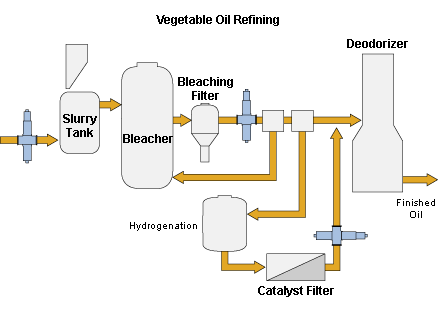
The Dangers of Refined Vegetable Oils

  The Dangers of Polyunsaturated Vegetable Oils 

From the pioneering research of Dr. Weston A. Price

What does refined vegetable oils have to do with pain? It is now widely known that these oils can disrupt our bodies on a metabolic lever. Often the trickle-down affect of this manifests as inflammation in the body.

The above title is a live link to an amazing article by Dr. Weston Price. Worth more then just a cursory read! Take a look and consider what oils you have been using in your kitchen add to that a deeper consideration of what you have been eating when you eat out a meal for breakfast, lunch or dinner! Always ask at your favorite restaurants "what types of oil they use?"
I promise you the answers will astound you.

Thanks for taking the time to take care of yourself by becoming more educated about these oils to avoid.


Blessings of Health and Goodness to you All.


_______________________________________________________________________________


Friday, June 22, 2012

Foods that Fight Pain


There are many reasons why we suffer from physical pain. Much of this may be due to do the types of foods we eat.....
.....and yet, pain can perhaps be alleviated to some degree by the foods we Do-Not regularly eat.

Below is a short list of foods that can prevent pain. 

___________________________

I am a HUGE fan of Ginger and Turmeric. I add these two Rhizomes to my morning vegetable juice just about every day & the results on my own stiffness and pain are very positive. They are among the most powerful, safe and effective anti-inflammatory foods that you can easily add into your diet and may already enjoy. Both Ginger and Turmeric have been used for centuries by cultures around the world for similar aliments.  To learn more about Ginger and Turmeric I highly suggest the book: Ginger Common Spice & Wonder Drug, written by Paul Schulick. It is a wonderful read and will truly enlighten you to the benefits of these two spicy Rhizomes.

__________________________

If you eat all these food you might have a stomach pain and then eat none of these food and you die.  PW

Turmeric. Turmeric contains a powerful anti-inflammatory compound known as curcumin. (In fact, turmeric is sometimes simply called curcumin.) This deep yellow-gold spice has a smoky, peppery flavor and is used in curries and mustard. "It's such a powerful anti-inflammatory, it's one of the spices I recommend eating every day," says integrative nutritionist Beth Reardon, director of nutrition at Duke Integrative Medicine, part of the Duke University Health System, who adds it to almond milk with cinnamon and a touch of honey.
Other examples: Garlic, ginger, cinnamon, tart cherry, curry, rosemary. (Dried tart cherries, while not technically a spice or herb, are another antioxidant-superstar way to "spice up" other foods.)
Why: Several studies have shown an anti-inflammatory effect of turmeric on patients with rheumatoid arthritis. These spices and herbs help inhibit the formation of inflammatory prostaglandins and COX inhibitors (the same enzyme-inhibiting substances in medications such as Vioxx or Celebrex).

Canned salmon. The fish highest in inflammation-busting omega-3 fatty acids, salmon, is available in cans year-round. "And it's the most affordable source of wild salmon," Reardon says. Wild-caught is healthier than farm-raised salmon, which may contain toxic chemicals and antibiotics, depending on their feed and the conditions they're raised in.
Other examples: Cold-water fish that supply omega-3 fatty acids include black cod, tuna, sardines, halibut, mackerel, herring, and anchovies. And for protein don't overlook legumes and dried beans, such as lentils, soybeans, and black beans, and ancient grains including quinoa, millet, and spelt. Plant sources of omega-3s include pumpkin seeds, walnuts, and flaxseed.
Why: Replacing animal protein with proteins from fish increases your consumption of DHA and EPA, so-called "long chain" omega-3 fatty acids, which have been linked to improvement in symptoms of both osteoarthritis and rheumatoid arthritis. Plant sources provide also-essential "short-chain" omega-3 fatty acids.

Coconut oil. Available in specialty groceries (such as Trader Joe's and Whole Foods), coconut oil provides good fuel for the cells that line the gut, which is fundamental to proper immune system functioning, Reardon says. You can use coconut oil in cooking and baking where a light, slightly sweet flavor is desired, or to pop popcorn (another plant food high in antioxidants).
Other examples: Olive oil, grape-seed oil, avocados, ground flax, nut butters (especially almond, almond-flaxseed, cashew, or sunflower seed, which are less inflammatory than peanut butter), omega-3-fortified eggs.
Why: You'll be displacing unhealthy, omega-6 saturated fats (found in highly processed foods), which far outnumber good-for-you omega-3 fats in most American diets -- a backwards ratio that fans inflammation. Healthy fat sources fuel both proinflammatory hormones, which fight stresses to cells, and anti-inflammatory hormones, which regulate the healing process after a threat (injury or infection) is gone.

Kale. It's fibrous, low in calories, rich in dozens of beneficial flavonoids, and is one of the most nutrient-dense greens. Chop it into vegetable- or bean-based soup, blend it in a smoothie, or add it to salad or pasta dishes. To bake kale chips, tear leaves into bite-sized pieces, sprinkle or spray on olive oil (one tablespoon per cookie sheet), and add some sea salt. "It's a pretty awesome vegetable," Reardon says.
Other examples: Whole grains, beans, lentils, and all dark green, red, orange, yellow, blue, and purple fruits and vegetables -- the whole rainbow. Rule of thumb: The more intense the color, the more antioxidants are packed inside. But even whites (cauliflower, garlic, onion) and blacks (black beans) provide plenty of benefits.
Why: A plant-based diet emphasizing whole (unprocessed) foods "is like a force field, or sunglasses, protecting your lipid membranes and DNA from oxidative damage," says Reardon. Ideally, amp up the plant foods at the same time you eliminate refined and processed foods (such as white flour, sugar, and packaged goods like cakes, cookies, chips), which can raise blood glucose, increasing insulin production and, in turn, inflammation.
Variety is the key word, because the cumulative effect of many different nutrients is what creates the beneficial synergy. As Reardon says, "It really does take a village."

Greek yogurt. This thick type of yogurt packs more than twice the protein of regular yogurt, and it contains probiotics -- live microorganisms that help supplement the healthy bacteria already in your digestive tract. It's also a good source of vitamin D.
Other examples: Probiotics are also found in any yogurt containing live cultures (check the label for Lactobacillus acidophilus and L. bifidus, two common types) and in any fermented food -- such as kimchee, sauerkraut, and kefir.
Why: Probiotics help your gut preserve a healthy balance of good bacteria, which are often under siege from factors ranging from poor nutrition and stress to smoking and pollution. "A healthy population of bacteria needs a plant-based diet to survive --it's its own biosystem that needs to be cultivated," Reardon says. This dairy food is another way to supplement that healthy ecosystem. It's especially beneficial after finishing a course of antibiotics, she says, which can disrupt the balance of healthy bacteria.

Green tea powder. Also called matcha, powdered green tea -- basically the tea leaves, finely ground --provide the same powerful antioxidants that green tea beverages do, but in a more concentrated and versatile form. In steeped tea, the liquid contains the water-soluble antioxidants from the tea leaves, but in tea made from green tea powder, you're literally consuming the whole leaf. Stir it into water (hot or cold) for tea, or add to smoothies or lattes. It can even be added to baked goods or soups.
Other examples: Water, green tea. Black tea and coffee also contain anti-inflammatory properties, but in lesser amounts. However, their caffeine can help treat headache pain.
Why: The vital organs and blood supply are composed of as much as 90 percent water. "Water is needed by the liver to help detoxify chemicals and the other compounds we come in contact with," Reardon says. Water helps all the body's processes work, right down at the cellular level.